Extra Innings, Chapter 17 · Last Road Trip Home
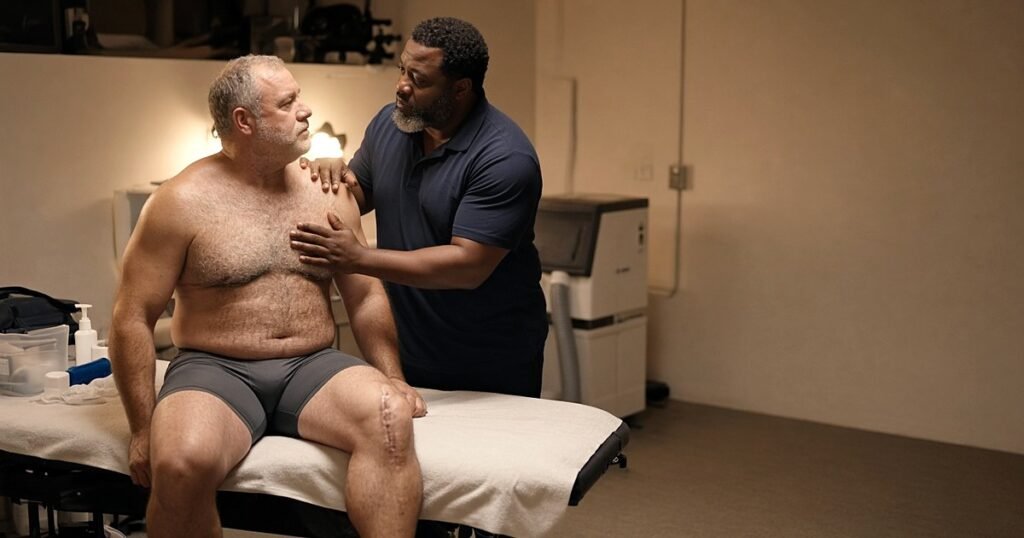
“It went in the mail slot at Curtis’s door at seven-fifteen,” Gil said. “And then I sat in this car for an hour.”
He had the engine off and his wrists hooked over the wheel. The truck was parked riverside of Rennie’s building, nose to the old loading dock, and the morning was grey and still, and a barge was going down the Missouri so slowly it might have been painted there.
Rennie had come down with two coffees because Gil had texted Outside. No rush. at nine, and Gil never texted anything with no rush in it. He rode shotgun now, parked with his own cup going cold between his knees.
“An hour,” he said.
“Give or take. I listened to the farm report twice.” Gil looked at the barge. “Soybeans are down.”
“I’m sorry about the soybeans.”
“So’s everybody in Nebraska.” Gil almost smiled. “It’s a page and a half. Typed. Haldane gets the original, Curtis a copy, HR a copy, because that’s what the paper I signed in September says happens. It says yes. It says I’ll be in Denver for spring training as the bench coach, if they still want me after they’ve read the rest of it, and the rest of it is about baseball. My knee, my back, the fact that I don’t fly well, the fact that I’ll want to sit in on the catchers. Three paragraphs on catchers. Nothing else.”
“Nothing else,” Rennie said.
“Not a word. Not your name. Not the word trainer. I read it through four times with a pen to be sure.” Gil turned and looked at him then. “That’s all I came to say. You should hear it from me first, and I meant to tell you in a car, and not in there.”
He nodded up at the building.
Rennie looked up at his own windows, third floor, the brick. Then back at Gil, at the grey stubble he hadn’t shaved since Wichita, at the reading glasses folded in the cup holder, at the hands on the wheel.
“All right,” he said. “Now you’ve said it in a car.”
“Now I’ve said it in a car.”
“Then come up,” Rennie said. “It’s an off day. I made eggs and then I came down here instead of eating them, and they’re cold, and I’ll make more.”
They had flown home from Albuquerque on Wednesday night after Game 2, the last road game of the year, a late charter, Gil dozing on the window glass with his knee sleeve on before the wheels left the ground. Rennie had sat across the aisle with his phone dark on his knee and the call to Houston, four days old now, still in his ears.
He’d made it at five o’clock on Sunday in Wichita, from the visiting training room after the season’s last regular game, with the door locked and the tape cart pushed across it for good measure. His mother had answered on the second ring and said his full name, as she always did when she’d been waiting.
He’d said: Denver, an interview, the head job, on my own record. He’d said: and there’s a man. Fifty-three. He manages the club. He doesn’t decide anything about me and never has, and it’s in writing.
His mother had said nothing for so long he checked the line. Then she’d said, Is he good to you? and Rennie had said yes, and she’d said, Does he eat? and Rennie had laughed so hard Turo knocked on the door to see if he was all right.
After that she’d asked about the interview, the dates and the city and whether he’d need a winter coat, a real one, not the thing he wore in Omaha and called a coat. She’d asked whether the man knew about the interview. Rennie had said yes, after, and that he’d been told after on purpose, and his mother, who had filled out forms in triplicate at a pharmacy counter for four decades, had said, That’s proper, that is, in her prescription voice, the one for a script written out correctly.
Then she’d asked his name, and he’d told her, and she’d said it back to him slowly, Gil, trying it, and said she’d pray for his knee.
That had been Sunday. Then two games in Albuquerque, a split, and the charter home.
Upstairs, Gil sat up at the table on the kitchen step and ate four eggs and three pieces of toast and drank the coffee Rennie made him, and didn’t say anything about Denver, and Rennie didn’t ask.
The condo was bright. The river light slanted in off the water and lay over the brick and the floorboards and the green chair in the corner, the old reading chair with its high back and its wide flat arms, and the matching ottoman Rennie had found at an estate sale in July and hadn’t yet decided where to put. It sat before the chair now, a little crooked, piled with the week’s mail.
Gil finished the toast. He looked at the chair over his cup.
“You moved it,” he said.
“The chair’s where it was. I bought a footstool for it.”
“It’s in a different spot.”
“It’s two feet to the left. The radiator was cooking the leather.” Rennie took Gil’s plate. “You’ve been in this room six times.”
“Seven. I count.” Gil put the cup down. “First time I was ever in here, that chair’s where I sat, and you told me what you wanted. I’ve thought about it on every plane since.”
Rennie put the plate in the sink and ran the water over it and didn’t turn round straight away.
“So have I,” he said.
He washed the pan. Gil dried it, because Gil couldn’t sit and watch a man do dishes, and put it in the wrong cupboard, and Rennie moved it, and Gil watched him move it and said, “That’s where I’d have put it, if I lived here,” and then flushed and studied the cupboard, and Rennie pretended not to see it, and then didn’t pretend.
“Say that again.”
“No.”
“Then I’ll remember you said it once.” Rennie hung the towel on the oven door. “How’s the knee? You were on a charter and then you sat in a pickup an hour.”
“It’s stiff. It’s fine. You looked at it Tuesday.” Gil flexed it, standing there by the stove in his socks. “The back’s the one. Two plane rides in a week. It’s locked up across here.” He touched his own lower back, the left side.
Rennie crossed and set his palm where Gil’s hand had been, and pressed, and felt the knot there, hard as a walnut.
“I’ll work on that,” he said. “Not now. Tonight, on the table, if you’re staying.”
“I’m staying, if you’ll have me.”
“Then tonight.” He took his hand away. “Not now.”
Gil looked at him.
“Not now because you want me to rest it,” he said, “or not now because you’ve got something else in mind for now?”
“The second.”
“Doc.” It came out low.
Rennie leaned back against the counter. He’d had coffee and eggs and nothing else since six, and he was as clear as he’d ever been in his life, and he said it plainly so that it would be clear for Gil too.
“I want you to ask me,” he said. “You’ve let me do the asking for weeks. Round Rock was mine. Wichita was mine. I liked it. Now I want to hear it from you. Whatever it is, ask me, in words, sober, at ten-thirty in the morning in my kitchen, and I’ll answer you the same.”
Gil was quiet. He laid the dish towel on the counter, folded, square.
“I’m as sober as a deacon,” he said. “Two cups of your coffee. Nothing since a beer in Wichita on Saturday night, one, and that was Lonnie’s fault.” He drew a breath. “I want the chair. I want you in it, back in it, your legs up over those arms, and I want to kneel up in front of you on that footstool and fuck you there, slow, by daylight, river on the brick. The stool’s the right height. I looked at it while I was eating. My knee goes on the cushion and nothing hard, and my back stays straight, and I can put my hands on the chair back and not on you, and watch your face throughout.” He stopped. “And when I’m near, I’d like to come out of you and have your hands finish me. Your hands. On you. I’ve wanted that since April. That’s what I want. Will you have that, or some of it, or none of it? Any of those is a fine answer.”
Rennie found that his hands were gripping the counter edge behind him. He let go of it.
“All of it,” he said. “Yes. I’ll have all of it.” His voice wasn’t quite his. “Condoms are in the bathroom cabinet, and the water-based lube. Second shelf.”
“Second shelf. I’ve seen it. I’ll get them.”
“And if the stool’s wrong for the knee once you’re on it, you say so and you get down, and we go to the bed.”
“I’ll say so.”
“Then go and get them,” Rennie said, “and I’ll move the mail.”
The mail went on the table. Rennie pushed the ottoman square in front of the chair with his foot, then stood back and checked the height of it against the chair seat and nudged it two inches closer. Then he took his shirt off.
Gil came back from the bathroom with the strip and the bottle in one hand and stood at the foot of the step and looked at him standing there by the green chair in his jeans and bare chest in the river light, and didn’t come down the step for a while.
“Come on,” Rennie said.
“I’m looking.”
“Look from closer.”
Gil took the step down one foot at a time, and crossed the rug, and put the things on the arm of the chair, and cupped Rennie’s jaw in both palms and kissed him.
Neither of them hurried it. Gil kissed slow when he wasn’t in a hurry, and this morning he had none, his thumbs along Rennie’s jaw, his mouth soft and then not soft, opening, his tongue sliding against Rennie’s, the coffee still on it. Rennie unbuttoned Gil’s shirt without looking and shoved it back off him and Gil let it drop. He got Gil’s belt open. Gil got his. They undressed each other by the chair like that, between kisses, clumsy, laughing once when Gil’s foot caught in his jeans and Rennie had to steady him by the elbow, and then they were naked in the middle of the morning with nothing drawn across the windows and the whole river going by.
“Nobody can see in,” Rennie said. “Third floor. The barge is a mile off.”
“I wasn’t worried about the barge.”
Gil’s cock was rising, thick, between them, and Rennie’s was stiff, had been since the kitchen, and they stayed pressed together a moment, not moving, belly to belly, Gil’s grey chest hair rough against his skin, both of them breathing.
“Sit,” Gil said. “Get in the chair, Doc.”
Rennie sat. The leather was cool under his back and warm where the sun had been on it. He slid low, tailbone near the front of the seat and his shoulders were deep in the high back, and lifted one leg and hooked his knee over the wide arm, and then the other, so his legs hung open over both arms and his feet dangled, and he was laid open in his own reading chair in the daylight, and Gil loomed above him, looking his fill.
“Well, would you,” Gil said, very quietly. “That’s a sight.”
He planted a hand on each arm of the chair, beside Rennie’s knees, and knelt onto the ottoman, the good left knee first, then the right, onto the padded top, and settled, kneeling up, his back straight, his hips level with Rennie’s. He shifted his weight. Then he checked his knee.
“Well?” Rennie said.
“It’s a good stool.” Gil smiled. “Knee says yes. Back says yes. I say yes.”
He picked up the lube from the arm of the chair and warmed a little between his fingers, and reached down, and touched him.
Gil’s fingers were thick and slow. He circled first, slick, pressing, watching Rennie’s face, and Rennie watched him back with his head on the leather, mouth open. Then one finger, in, slow, all of it, and out, and in, and Rennie’s legs tightened over the chair arms and the leather creaked.
“Talk,” Gil said. “Give me a report, Doc.”
“It’s slow.”
“I know it’s slow. What else.”
“It’s full.” Rennie’s breath caught. “It’s not enough. Two.”
Two, then. He worked them deep and turned them and spread them, unhurried, and leaned forward over Rennie with his free palm planted on the high leather by Rennie’s ear, and kissed him through it, deep, so Rennie moaned into his mouth.
“That,” Gil said against his lips. “There. Again.”
The sound came again when Gil curled his fingers. He couldn’t stop himself. Gil found the place and leaned on it and kept pressing, and Rennie’s hips rolled up off the leather to meet him, and the chair’s leather creaked beneath them, and the river light lay across Gil’s forearm and his wet fingers and Rennie’s spread knees.
“Three,” Rennie said. “Gil. Three.”
Three, then, and Rennie stopped thinking about anything.
It stung and opened and stung again. Gil was patient. He kept his fingers still and let Rennie breathe into the stretch and then moved them, a little, and a little more, and talked low the whole while, about the light, about how Rennie looked in that chair, about how he’d sat in it the first night with his heart in his mouth and Rennie on his knees in front of him and thought he’d never get to see the chair again.
“You’re seeing it,” Rennie managed.
“I’m seeing it. I’m seeing you in it.” Gil eased his fingers free. “Ready?”
“I’ve been ready since the eggs.”
Gil laughed and bit the packet open and sheathed himself, and slicked the latex, and took the chair arms on either side of Rennie’s legs, and leaned in.
He came into Rennie slow, kneeling up, his back straight, his arms braced on the chair. Rennie watched it. He looked down his own body and watched Gil’s thick cock push into him, the crown, then the shaft, slow, gleaming, and felt it at the same time, the long stretch and fill, and both together made his head swim. Gil watched too. His eyes went from Rennie’s face down to where they were joined and back up, his mouth open, breathing with it.
When he was fully in he stopped and stayed there and bowed his head until his forehead touched Rennie’s.
“Hello,” he said.
Rennie laughed, helplessly, and clenched around him, and Gil groaned.
“Hello yourself. Move.”
Gil moved.
The ottoman gave him a base and the chair gave Rennie a cradle and the angle between them was exactly right, Gil’s cock sliding in and up against where his fingers had worked, every stroke. He went slow and long, nearly out and then home again, rolling his hips, his arms braced, the chair creaking with each push. Rennie’s legs hung open over the arms and swung a little with it. His hands didn’t know where to go and then found Gil’s sides, his ribs, the soft heavy flesh at his waist, and stayed there, feeling him work.
“What’s it like now?” Gil said. “Tell me.”
“You,” Rennie said. “All of you. Deep. Every time. Gil.”
“Louder.”
“Gil.”
The name went off the brick. Gil drove in harder at the sound of it, and then again, the stroke shortening, quickening, and the chair tipped and bumped the brick and Rennie didn’t care. Above him Gil’s face was flushed, sweating, wide open. He was saying things, low, broken, about the daylight, about the river, about how he’d go to Denver and come home every chance he got and want this, this chair, this man in it, and Rennie heard every word and felt every stroke and couldn’t answer any of it with anything but sounds.
Rennie’s cock lay stiff on his belly, leaking, sliding against his skin with every push. He took hold of himself.
At first he didn’t stroke. He kept it pressed flat to his own belly in a loose grip, and let Gil’s rhythm do the work, each push into him rolling his cock against his own palm, and the slow pressure built. Then he did stroke, short and tight, just under the head, in time with Gil, his thumb pressing up under the crown on every stroke, and Gil looked down and saw it and made a rough, cut-off sound.
“Doc,” Gil said, hoarse. “In your own chair. Doing that. Stroke it for me. Let me watch you shoot.”
Rennie couldn’t answer. He worked himself in short tight pulls, his legs shaking over the chair arms, Gil fucking into him steady and deep, and it rose and rose, and he looked up into Gil’s face and Gil was looking back at him, close, their foreheads nearly touching, and he came looking into Gil’s eyes.
He came hard. His spine bowed off the leather and his legs locked over the chair arms and he clenched down on Gil so tight that Gil cried out, and his cock jerked against his palm and shot hot across his stomach and chest, again, and again, striping him, and Gil fucked him slowly through each pulse, his arms braced, his forehead pressed to Rennie’s, saying yes, yes, yes.
Then it ebbed. Rennie lay in the chair, chest heaving, come cooling on his skin and Gil still hard inside him.
“Now,” Rennie said, when he could. “Your turn. Come out of me and let me.”
Gil drew out slowly. Rennie hissed at the drag of it and Gil kissed his knee where it hung over the chair arm. Then Gil stripped the condom off and let it fall by the ottoman, and knelt up again, his cock dark and swollen and glistening, bobbing just above Rennie’s belly.
Rennie reached for him with both hands.
He’d wanted this for months. Both hands, slick with lube and his own come, one wrapped round the shaft and the other cupping the heavy balls under it, rolling them, tugging gently, while the first hand stroked, long and firm and twisting over the head. Gil’s arms shook on the chair back. His head dropped. He was making sounds Rennie hadn’t known were in him, low and helpless, and his hips were moving, fucking up into Rennie’s grip in little jerks.
“Tell me,” Rennie said, giving Gil his own word back.
“Close,” Gil got out. “Rennie. Close.”
“On me. Go on. I want it on me.”
Gil came with a cry dragged up from his belly, his whole body bowing over Rennie’s in the chair, and his cock jerked in Rennie’s hands and spilled onto Rennie’s belly and chest, hot, thick, over Rennie’s own come, again and again, Rennie stroking him through it, slower, slower, until Gil shuddered and grabbed his wrist and said, “Enough, enough,” and Rennie let go at once.
Gil’s arms gave. He came down slowly, carefully, onto Rennie in the chair, chest to chest, the mess between them, his face in Rennie’s neck, his knees still on the ottoman. The chair took them both. Rennie wrapped his arms round Gil’s shoulders.
They stayed like that until Gil’s knee said otherwise. Then Gil got off the ottoman with a hand on the chair arm and a sound like an old door, and stood, swaying, and swore mildly at himself, and went for a towel.
Rennie stayed in the chair. He was glued to the leather. He didn’t care.
Gil brought a warm wet towel and a dry one and sat down on the ottoman and cleaned him, slowly, belly and chest, and Rennie let him.
They slept after that, in the bed, in the middle of the day, with the blinds half down and the river noise coming through the window Rennie had cracked. Gil slept flat out, an arm over his eyes, snoring like a tractor in a far field. Rennie slept on his front beside him and woke at two with the sheet stuck to his cheek and Gil already awake, looking at the ceiling.
“You’re thinking,” Rennie said.
“I’m counting cracks. You’ve got eleven.”
“The building’s a hundred and four years old. It’s earned them.”
They got up at three and walked. Gil wanted to, said the knee needed it and the back needed it, and Rennie agreed, because both things were true. They went down the river path toward the bridge, past the dog people and the runners and a man fishing for nothing off the old pier, Gil in a Stockmen windbreaker and a ball cap pulled low, Rennie in a sweatshirt from the Big Ten programme with the cuffs gone to threads. Nobody looked at them twice. Two men in their forties and fifties walking a river path on a Thursday afternoon in September, the day before a playoff game. Omaha had seen a few.
Halfway to the bridge Gil stopped at the rail and stretched his back, both hands on the small of it, and groaned at the sky.
“Tonight,” Rennie said. “On the table. You’ll be a new man.”
“I’d settle for the old one with less wear on him.”
“I can’t do miracles. I can do the left side of your lumbar spine.”
Gil laughed and they went on. At the bridge they turned round. Heading back, a woman with a stroller recognized Gil, or half did, and said, “Aren’t you…?” and Gil said, “Most days,” and tipped his cap, and the woman laughed and went on, and Rennie walked the next hundred yards with his face hot and his chest full and didn’t know why.
They didn’t talk about anybody’s job. Once, near the pier, Gil started a sentence with “In the spring,” and stopped, and looked at the water, and finished it with “the river’s higher than this,” and Rennie let it stand.
At home Rennie cooked. Chicken, rice, the greens his mother would have asked about, and Gil sat up at the table on the step and watched him and peeled the label off his water bottle in one long strip. At eight Rennie put the folding table up in the middle of the living room, the portable one from his trunk, and laid a sheet on it, and Gil got onto his front without being asked, and Rennie worked on the knot in his back for forty minutes with his thumbs and his elbow and the flat of his palm until it gave, all at once, and Gil groaned a word into the face cradle that made Rennie laugh.
“There,” Rennie said. “It’s gone. You’ll feel it tomorrow and then you won’t.”
“I feel it now.”
“You’ll feel it differently tomorrow.” He scrubbed up at the kitchen sink, dried off, returned, and said, “That’s me done working tonight,” because he always said it, every time, even when nothing was going to come after it.
Gil pushed himself upright on the table in his shorts wrapped in the sheet. The lamp was on and the river had gone black in the window behind him.
Rennie took the green chair facing him. The ottoman was between them.
“There’s a question I’ve got,” Gil said.
Rennie looked at him.
“Not about Denver,” Gil said. “Not about anybody’s job. About us.” He turned the dry towel over in his hands. “When this is over, the season, the interviews, all of it, whatever happens with any of it, I’d like there to be an us. Wherever it is. In two cities if it’s two cities. I’m too old to do it any other way than say so.” He looked up. “Do you want that?”
Rennie leaned forward in the chair, across the ottoman, and put his hands on Gil’s knees, the bad one and the good one.
“Yes,” he said.
Fiction by the Woolnight editorial team. AI-assisted drafting; reviewed and edited by humans before publication.