Extra Innings, Chapter 18 · Extra Innings
The board said it first.
Up on the left-field scoreboard, under the innings, under the runs and the hits and the errors, a white square lit that Gil had not seen in a championship game since he was a player: 10. Then the E, and the I. Extra innings. The park made a sound, one long rising thing, and Gil set both palms on the dugout rail and watched the board as if it might take it back.
He had managed nine innings of a Game 5 that had gone 2–2 into the ninth and then into this, and his knee was a dull bar of heat under the sleeve, and his back had locked somewhere around the seventh, and none of that mattered. Lonnie stood at his elbow with a fungo bat across his shoulders like a yoke. Frye had stopped chewing. In the stands the Sunday crowd of twenty-two thousand was on its feet, and in the tunnel behind them Turo was already moving ice, because Turo always moved ice when the innings went long.
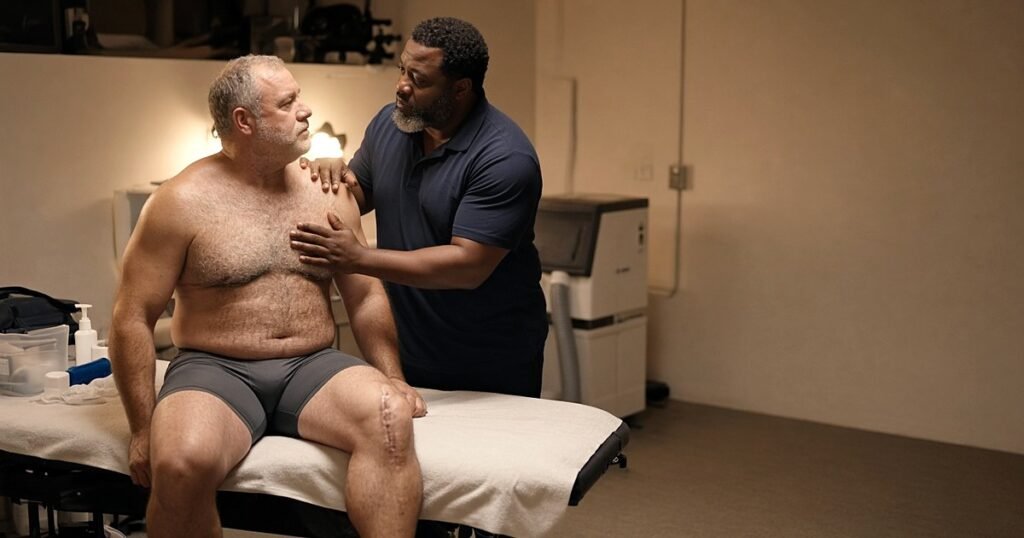
Rennie was down at the dugout’s far end with his kit open on the bench, wrapping Pike’s shoulder between innings as if this were any other Sunday. He looked up once, caught Gil looking, and looked down again. The room knew. The room had known since August. The stands did not. The stands saw a skipper and a trainer doing their jobs in the tenth inning of a championship game, and that was all they were going to see.
“Bud,” Lonnie said.
“I know.”
“Wexler’s got one more in him. Maybe.”
“He’s got one more. Then we go to the pen.”
Lonnie nodded and spat seed husks into the dugout dirt and said nothing else. That was Lonnie’s whole gift.
The tenth went nowhere. The eleventh went nowhere. Albuquerque’s closer threw fourteen pitches late in the eleventh and got a pop-up, a foul tip their catcher somehow kept in his mitt, a pop-up, and a ground ball to short. Three up, three down. Gil wrote the twelfth on his card with a hand that did not shake and told Lonnie to get Wexler one more out of the pen if he had to, and Lonnie said he already had the phone at his ear.
In the hole between innings Rennie came down the dugout with a fresh roll of tape and did not stop at Gil’s end. He stopped at Pike. He stopped at the water cooler. A hand landed on Wexler’s back, between the numbers, and Rennie said something Gil could not hear, and Wexler nodded once, sharp. Then Rennie went back to his kit without looking over. Gil did not make him.
“Bud,” Lonnie said again, softer.
“I heard you the first time.”
“I wasn’t talking about the pitcher.”
Gil kept his gaze on the field. “Then don’t.”
Lonnie spat husks. “All right. I won’t. But when this is over, you ice that knee before you ice the champagne. Doctor’s orders. Not mine.”
“He’s not a doctor.”
“He is to me,” Lonnie said, and went to the bat rack.
They won it in the twelfth.
Villalobos, who had made the catch that clinched the division in Round Rock, lined a ball into the right-field corner with one out and a man on second, and the man scored standing up, and the park came apart. Gil did not move for a second. The runner touched the plate. The umpire’s arms went up. Gil’s own club poured out of the dugout and the bullpen and the dugout again, a wave of grey and red, and then he stepped up onto the grass and walked out into it.
Somebody put a hat on his head that was not his. Somebody poured something cold down the back of his jersey. Lonnie hugged him, hard, and said a thing into his ear that Gil would not remember later and did not need to. Frye was crying, openly, which Frye had said he would never do. Pike was on somebody’s shoulders. Wexler was sitting on the mound, glove on his face.
Villalobos found Gil amid the pile and shook his hand, formal, as if they were meeting in a hallway and not on a field full of grown men losing their minds. “For Round Rock,” Villalobos said. Gil nodded. He could not speak yet. He clapped Villalobos once on the shoulder and let him go back to the pile. Reyes had a phone up once more, Denver on the other end, and Gil could see the tiny face yelling congratulations through the glass. Somewhere a camera flash went off, and another, and Gil turned his shoulder without thinking, an old habit from years of not wanting his private face on anybody’s front page.
Rennie came out last, walking, not running, his kit still in his hand, because somebody on the field might need him. He stopped a few yards short of the pile. Gil saw him over Lonnie’s shoulder. For a second they looked across the grass at each other, two club colleagues, and Gil raised a hand, once, open, and Rennie raised his kit an inch in answer, and that was what the cameras got, if they got anything.
The room knew. The stands did not. The stands saw a championship.
The series had gone the long way. Split in Albuquerque, Game 3 won at home on Friday behind Wexler, Game 4 lost on Saturday in a bullpen mess Gil was already rewriting in his head for next spring. Game 5 had been scoreless into the sixth, then a two-run shot by their third baseman, then Villalobos tying it in the eighth with a double into the same right-field corner he would find again in the twelfth. Gil had used every arm he trusted and one he did not, and the one he did not had thrown a clean ninth and walked off to a silence that was its own kind of cheer.
It took two hours for the park to empty.
Interviews. Champagne in the clubhouse, the cheap stuff and Lonnie’s good stuff, plastic over the lockers again. Curtis said a speech. A man from the Rails said a speech. Gil spoke three sentences into a microphone and meant two of them. He did not drink. He stayed at the heart of it, arms folded, and let them soak him, as he had in Round Rock, and when a bottle came into his hand he passed it on.
Pike tried to hand Gil a cigar and Gil shook his head. Frye tried to pour champagne into the collar of Gil’s jersey a second time and Lonnie intercepted him with a look that had ended arguments in bullpens for twenty years. Someone started a chant that used Gil’s last name and got about four syllables in before it fell apart into laughing. Curtis caught Gil’s eye over the mess and tipped an invisible cap; Gil tipped a real one back.
Rennie stayed at the edge of it, dry, answering questions about ankles and shoulders and whether Teague would be ready for a call if the Rails asked. He did not look at Gil. Gil did not look at him.
Gil found Rennie once more before midnight, in the training room, restocking the tape cart as if the season had not just ended. The door was open. Gil stood in it.
“You should go home,” Gil said.
“So should you.”
“I’m going to walk the field when they’re done with me. Habit.”
“Then I’ll lock up after you.” Rennie slotted brown tape into the wrong row, caught himself, moved it. “Curtis wants you upstairs at eleven for the Rails call. I already told him your knee needs ten minutes of ice before you climb those stairs.”
“You told Curtis.”
“I told Curtis. He said all right. He’s been saying all right to me since July.” Rennie closed the cart. “Go ice. I’ll be here.”
Gil iced in his office, door open and the wedge in his hand, not under the door, a bag on the knee and a bag at the small of his spine, and listened to the building shout itself empty. At eleven he went upstairs. At eleven-forty he came down. The Rails man had been pleased. Curtis had been pleased. Gil had been tired. He had said the right things about the club and the city and the twelve innings and had said nothing about any person except the players who had earned the right to be named.
By midnight the clubhouse was a wreck of plastic and wet carpet and empty bottles, and the players had gone, in packs, to wherever players go when they have just won the whole thing. Turo was pushing a mop. Lonnie had taken Frye to a steakhouse. Curtis had gone upstairs with the Rails man. The corridor lights were still on. The field lights were still on.
Gil walked out through the dugout and came up onto the dugout’s top step and looked out at his park.
Empty. The board still showed the twelve and the final, 3–2. A few cups rolled in the lower seats when the wind caught them. The infield dirt had been chewed soft. Out beyond center the Missouri was a black line under the sky.
He heard footsteps on the dugout boards behind him and did not turn.
“Skip,” Rennie said.
“Doc.”
Rennie came up beside him on the step, kit left behind somewhere, hands empty. He smelled of champagne he had not drunk; the whole building smelled of it.
“You should ice that knee,” Rennie said.
“I know.”
“And the back.”
“I know that too.”
They stood there. A cup rolled. Somewhere in the upper deck a door slammed.
“I locked both doors,” Rennie said, after a stretch. “Corridor and the office. Turo’s got the clubhouse. We’re the last ones on this level.”
Gil turned his head. Rennie was watching the board, not him.
“Are you asking me something,” Gil said, “or telling me something.”
“I’m telling you the doors are locked.” Rennie looked at him then. “And I’m asking if you want to come off this step and into your office with me, and shut that door too, and put a towel under your knee, and fuck me on the floor where you write the lineup. I’ve wanted that since the tenth inning. I’m sober. I’ve had water and a sandwich at seven. I want you to say what you want.”
Gil looked at him under the empty park light. Fifty-three years old, a championship ring that did not exist yet waiting in a box somewhere, a letter to Denver already mailed, a man standing next to him on a dugout step who had put Pike on hold in June and never once traded a call for a thing.
“I want that,” Gil said. “The whole of what you named. Same as you said. And when I’m near I want to ask you before I finish, and I want the answer to be yours. And after that I want to take you in my mouth, down here, so I can watch your face while you do. That’s what I want. You can take any of it back.”
“I’m not taking any of it back.” Rennie’s mouth moved. “There’s a strip in your desk drawer. Left side. I put them there in May and I’ve watched you not find it all season. The water-based lube’s with it.”
“You put condoms in my desk.”
“I put them in your desk. Are you coming.”
The office was unchanged: desk, two chairs, the board on the wall with magnets for the roster, the window onto the tunnel, and carpet that had never quite matched the clubhouse carpet. Gil locked up and slid the wedge under the door, because he had once propped a door open every day for six months and then shut it, and he knew what a wedge was for.
Rennie was already at the desk. He opened the left drawer and took out the condom strip and the lube bottle and put both on the blotter, and then he took off his polo and let it drop on the visitor’s chair. The river light was gone; the tunnel light came through the window, yellow and thin.
Gil stripped off his jersey. The undershirt after. He got a clean towel out of the bottom drawer, the one he kept for spills and for nights like the nights he had not let himself plan, and folded it once and set the towel on the carpet by the desk.
“Knee,” Rennie said.
“Knee. Back’s going to complain later. Knee first.”
“Say it if either one says no.”
“I’ll say it.”
Rennie unbuckled his belt. Gil watched him. He had watched Rennie undress in hotel rooms and in a condo on the river and once, months ago, in this same building with Turo through the wall, and it never got old. Rennie got out of his pants and his shorts and stood in the tunnel light, forty years old, dark and solid, his cock rising, already half hard.
“Hands and knees,” Gil said. “Beside the desk. Looking at the window if you want the tunnel, or looking back at me over your shoulder. Your pick.”
“Looking back at you.”
Rennie went down on the carpet, palms flat, knees apart, back long, and looked over his shoulder at Gil, and Gil had to pause and breathe.
He got his own pants off. He knelt behind Rennie on the folded towel, right knee down, left foot planted, weight on the left, back as straight as a dugout rail. The rebuilt knee took the towel and did not shout. He ran both palms up Rennie’s sides, across his ribs, and down again, and then reached for the bottle.
“Cold,” he said.
“I know. Do it.”
Gil took a second. He looked at Rennie braced on palms and knees on office carpet, at the line of his spine, at the dark muscle of his legs, at how the tunnel light cut across him. He had managed a twelve-inning Game 5 and won a championship and mailed a letter to Denver, and the thing he would remember when he was seventy was this: Rennie Okafor on the floor of his office, waiting for him, after the park had emptied.
Fingers slick, he opened Rennie slow, one and then two, watching the line of Rennie’s back change, listening for the sounds Rennie made when he stopped pretending he was quiet. Rennie pushed back onto his hand. Gil worked him open with a patience he did not feel. He curled his fingers until Rennie’s elbows buckled, and stayed on it until Rennie was rocking on his hand and saying please without shame. Three, when Rennie asked for three. Then slow and deep again until Rennie said, “Now, Skip. Now.”
Gil rolled the condom on, slicked it and lined himself up. He set one palm on the carpet beside Rennie’s knee and braced the other at his own hip, and pushed in.
Slow. Rennie was tight and open at once, as he got after waiting through a long game, and Gil sank into him bit by bit with his jaw locked and his gaze on Rennie’s nape. Halfway he stopped. Rennie pushed back and took the rest himself, and Gil’s breath left him all at once. When his hips came flush he stopped and stayed, both of them breathing, the office quiet, the park quiet beyond the door. He could feel Rennie’s heartbeat where they joined. Or he imagined he could. Same difference, tonight.
Gil found his voice under the pulse in his throat. “You’re perfect. You’re on my office floor and you’re perfect. I’ve wanted you here since April and I never once wrote it on a card. You and the locked door and the towel under the knee and the board on the wall with every name I’m supposed to care about, and the only name in my head is yours.”
“Move.”
Gil moved: short first, then longer, rocking from the hips so his back stayed straight and his knee stayed kind. The towel stayed put. Rennie dropped to his forearms and the angle shifted and Gil groaned and had to stop again, deep, and Rennie laughed into the carpet, breathless.
“That,” Gil said. “That’s the one. Stay there.”
He fucked him like that, steady, the desk a foot from Rennie’s head, the roster board watching them with its magnets, the tunnel light laying a bar across Rennie’s shoulders. Rennie met every stroke with a push back. The sound of skin and breath filled the small room. Gil’s knee stayed quiet on the towel. His back stayed straight. He could have done this until dawn and the only thing that would have stopped him was Rennie saying so.
He varied it. Slow and deep, then shorter strokes that made Rennie’s hands curl on the carpet, then slow again. Gil leaned down once, mouthed Rennie’s shoulder blade, tasted salt, straightened before his back could complain. Rennie’s cock swung under him, hard, and Gil watched without touching and said so.
“I’m not touching it,” Gil said. “You’re going to finish on my tongue after. I want you hard for that. Can you wait.”
“I can wait. Barely. Don’t stop.”
“Not stopping.”
He settled into a pace that made Rennie’s arms shake and kept it. The desk creaked when Rennie’s shoulder bumped it. A magnet fell off the roster board and hit the carpet and neither man cared. Gil’s breath was loud. Rennie’s was louder. Outside, far above, a door slammed and footsteps faded, and then the building was theirs again.
He talked, as he always did. He told Rennie what he looked like from behind, open and taking him. The twelfth inning came out of him next: Rennie at the dugout’s other end not looking at him, and the long minutes of it. Then the hat somebody had jammed on his head, and looking for Rennie over Lonnie’s shoulder before he looked for anybody else.
“About this,” Gil said, driving in harder, once, and Rennie loosed a sound that bounced off the desk. “About you on your knees in my office after we won the whole thing. About me in you. About the carpet under my palm, which I’m going to remember every spring for the rest of my days.”
“Gil.”
“I’m here. I’m not going anywhere.”
Rennie’s cock hung heavy under him, swinging with every stroke. Gil watched it and did not reach for it. He braced his palms on his own legs and fucked into Rennie with everything the knee would give him.
Gil’s rhythm went ragged. The edge of it was close, and he slowed on purpose because he had promised to ask and he was going to ask while he still could.
“I’m getting there,” Gil said, rough. “I said I’d ask. I want to spend it inside you, on this carpet. Say which: in, or out.”
Rennie turned his face against his forearm. His eyes and mouth were open, his throat flushed.
“Inside,” he said. “Stay. Come in me. Now.”
Gil stayed. He thrust in three more times, deep, and came mouth open, no sound at first, then a long low one he could not stop, his whole body shaking over Rennie’s, the condom catching all of it while he pulsed and pulsed and kept himself up on a locked left leg and a right knee that had, for once, no opinion. Rennie pushed back through it, taking him, talking him through it in broken words Gil would keep: yes, Skip, like that, give it to me – and then he laughed, breathless, and said, “I’ve waited all year for this floor,” instead.
He pulled out carefully. Back onto his heels on the towel, breathing, a palm on the carpet, Gil looked at Rennie still on his forearms and knees with his head down.
The office smelled of sex and old coffee and the champagne that had soaked into Gil’s hair two hours ago. From the corridor, nothing. From the field, nothing. Gil could hear his pulse in his ears and the soft tick of the wall clock over the roster board, and under that, Rennie’s breathing as it came back down.
“You all right,” Gil said.
“I’m all right. Give me a second. You’ve scrambled me.”
“Take it.”
Rennie laughed, once, into his forearm. Then he pushed up onto his hands again and rocked back onto his heels, still facing away, and rolled his shoulders. Gil watched the muscles move under his skin and wanted him all over again, which at fifty-three after a twelve-inning game was either a miracle or a medical event. He decided not to ask which.
“Come here,” Gil said. “Up. On your knees. Face me.”
Rennie pushed up and turned and knelt in front of him, near, his cock hard and dark, wet at the end. Gil shifted, got his back against the side of the desk, got the towel under his right knee again, and leaned in.
“This,” Gil said. “My mouth. You set the pace. If you need me off, a tap on my shoulder is enough information. Not a rule we’re setting. Just so I know.”
“I know. I won’t need it. I want this.”
“Then take it.”
Gil took him in.
He worked as he liked when he had time: slow at the head, tongue working, then deeper, his hands on his own knees, not on Rennie. Rennie’s hands stayed at his sides and then rose and hovered and settled on his own legs. Gil looked up. Rennie was looking down at him, mouth soft, eyes blown, the tunnel light in his hair. A drop of sweat ran from Rennie’s temple to his jaw and fell on Gil’s cheek. Gil did not wipe it off.
“Gil,” Rennie said. “Gil. I’m – “
Gil answered him with a low sound and took him deeper. Rennie’s hips hitched. Gil stayed still and let Rennie use his mouth, short careful thrusts at first, then deeper as Gil breathed through his nose, taking him. Rennie’s voice broke on Gil’s name. Gil’s hands stayed on his own knees. One of Rennie’s hands hovered over Gil’s hair and did not land, and Gil was done for, for that.
“Now,” Rennie got out. “Now, Skip – “
Gil stayed on him. Rennie made a broken sound and spilled across Gil’s tongue, hot and thick, and Gil swallowed and swallowed and stayed through it, eyes open, watching Rennie’s face go wrecked and then quiet. Rennie shuddered and tipped forward, catching himself on the desk edge over Gil’s head, and Gil eased off him slow and rested his forehead against Rennie’s hip.
Rennie pulled back. He sat down hard on the carpet beside Gil, shoulder to shoulder against the desk, both of them breathing as if they had run.
They sat on the office floor a long while. Gil got the condom off, knotted it, pitched it into the wastebasket under the desk. Rennie found the towel and cleaned them both up, wordless, careful of Gil’s knee.
After a while Rennie leaned his head on Gil’s shoulder, and Gil let him, and they listened to the building settle.
“We won,” Rennie said.
“We won.”
“You’re going to Denver.”
“I’m going to Denver. You’re going to interview for Denver.”
“On my own record.”
“On your own record.” Gil turned his head enough to put his mouth in Rennie’s hair. “Whatever they decide, I already decided about you. Thursday. In your chair. That stands.”
“That stands,” Rennie said.
“This club earned its win. You earned your interview. Two reasons to be glad.”
Rennie was quiet for a stretch. Then he said, “My mother wants to know if Denver has a real winter coat store. I told her I’d look.”
“There’s a place on Seventeenth. I looked it up when I couldn’t sleep.” Gil almost smiled against Rennie’s hair. “Buy the heavy one. October up there doesn’t joke.”
They dressed slowly. Gil found his undershirt under the desk and his jersey on the visitor’s chair. Rennie put his polo back on inside out and then fixed it, swearing at the shirt, and Gil laughed at him and got sworn at for laughing. The towel went into the bottom drawer again, to be dealt with tomorrow. Bottle and strip went back in the left drawer.
Gil unlocked the door and took the wedge out. Rennie picked up his kit from where he had left it, which was just outside in the corridor. They walked together down the tunnel and out through the dugout and onto the grass one more time.
Neither of them spoke on the walk. The championship was on the board. Denver was in the mail. The rest was going to take months, and interviews, and forms, and none of it was going to become solved past midnight, on a field with the lights dying.
The board still said what it said. The cups had stopped rolling. High up, section by section, the lights were going out. Left field first, a long darkening. Then center. Then right. The scoreboard stayed lit a little longer, the twelve and the 3–2 still burning, and then that went too, and the park was only the moon and the exit signs and two men standing in the dirt.
Gil found Rennie’s fingers with his own. He did it without looking, as if he were taking a lineup card from Lonnie, and Rennie allowed it. They stood until the last bank of lights over the upper deck clicked off, and the season was over.
Fiction by the Woolnight editorial team. AI-assisted drafting; reviewed and edited by humans before publication.